← Home · Laboratory

Laboratory CBR Testing for Pavement Design in Laramie, WY

Together, we solve the challenges of tomorrow.

LEARN MORE →

At 7,165 feet above sea level, Laramie’s subgrade materials behave differently than those in the basins below. The combination of decomposed granite from the Sherman batholith, thin residual soils over bedrock, and winter frost depths reaching 48 inches means that pavement sections designed without local CBR data tend to fail early—often within three to five freeze-thaw cycles. When a contractor calls us after a premature rutting failure on a county road or an industrial yard, the first thing we request is the original laboratory CBR report, and more often than not, it was either skipped or run on air-dried samples that never saw a soaking cycle. In a city where the water table along the Laramie River corridor rises seasonally and clay-rich loess pockets in the western bench areas hold moisture well into June, the soaked CBR value is the only one that counts. Our approach to the laboratory CBR test in Laramie follows ASTM D1883 procedures but adds a conditioning sequence that mimics the localized wet-dry cycling we observe in Albany County subgrades.

A soaked CBR value of 3 on Laramie’s western loess means the difference between 6 inches and 14 inches of base aggregate—and that difference shows up in the first spring thaw.

Methodology and scope

The geologic patchwork underlying Laramie ranges from Precambrian granite outcrops on the east side to Quaternary alluvium and terrace gravels along the Big Laramie River, with isolated lenses of wind-deposited silt capping the higher terraces. This variability shows up directly in the soaked CBR results: a sample taken from weathered Sherman granite may yield a soaked CBR of 25 or higher, while a silty loess sample from the west bench can drop below 3 after 96 hours of soaking. Standard AASHTO T 193 and ASTM D1883 procedures specify a 4-day soaking period under a surcharge weight, but the fine-grained soils common in Laramie’s residential subdivisions often require extended saturation monitoring because the low hydraulic conductivity delays full moisture conditioning. We run the test with a mechanical loading press calibrated to 0.05 in/min penetration rate, recording load-penetration curves at 0.1-inch intervals and correcting for surface irregularities per the standard. When the subgrade material includes gravel particles larger than 3/4 inch—common in the alluvial fan deposits near the mouth of Soldier Canyon—we apply a scalping replacement method rather than discarding the oversize fraction, which would artificially inflate the CBR value and lead to under-designed pavement sections. For projects where WYDOT specifications require a correlation between laboratory CBR and resilient modulus, we pair the test with a triaxial shear evaluation that captures the stress-dependent stiffness behavior of partially saturated subgrade soils.
Laboratory CBR Testing for Pavement Design in Laramie, WY
Technical reference image — Laramie

Local geotechnical context

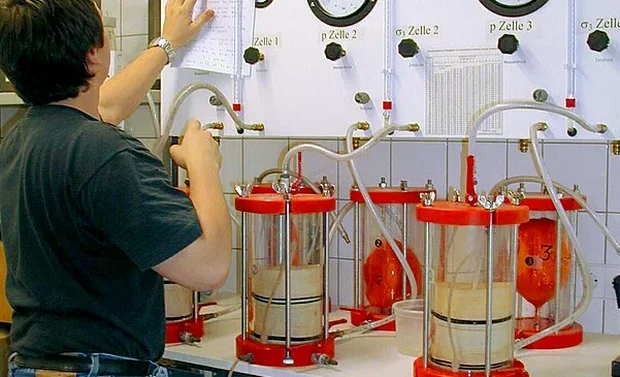
The loading frame we use for Laramie-area projects is a 50-kN capacity screw-jack press with a calibrated load cell and a displacement transducer reading to 0.001 inch—not a lightweight benchtop unit that drifts under sustained load. This matters because the fine-grained soils from the Casper Formation outcrops in the southern part of the county generate swelling pressures during soaking that can lift a poorly anchored surcharge plate, invalidating the entire test. The most common failure mode we encounter in third-party CBR reports is insufficient moisture conditioning. A sample compacted at optimum moisture and soaked for only 48 hours may still be absorbing water when the test begins, producing an unrealistically high CBR that disappears after the first wet spring. We see this pattern repeatedly on collector streets in Laramie’s newer subdivisions, where pavement distress appears within 18 months of construction. Another risk specific to high-plains environments is running the test on air-dried samples without restoring field moisture. The expansive smectite clays present in some Laramie Basin paleosol layers shrink dramatically upon drying; rewetting during soaking produces a CBR value 40 to 60 percent lower than a sample that never dried out. For design-build projects that require IBC Chapter 18 subgrade compliance, we document the complete moisture history of every specimen so the engineer of record can verify that the reported CBR reflects the worst-case saturated condition rather than an optimistic laboratory artifact.

Need a geotechnical assessment?

Reply within 24h.

Email: [email protected]

Typical values

ParameterTypical value
Test standardASTM D1883 / AASHTO T 193
Sample preparationCompacted at optimum moisture (Standard or Modified Proctor per ASTM D698 / D1557)
Soaking period96 hours under surcharge mass (minimum 4.5 kg annular and slotted weights)
Penetration rate0.05 in/min (1.27 mm/min)
Surcharge during penetrationEquivalent to pavement weight (typically 10–20 lb surcharge rings)
Swell measurementDial gauge or digital LVDT, readings at 0, 24, 48, 72, and 96 hours
Reporting valuesCBR at 0.1 in and 0.2 in penetration; corrected value if 0.2 in exceeds 0.1 in reading

Related services

01

Standard Soaked CBR (Single-Point)

One sample compacted at optimum moisture, soaked 96 hours, tested at 0.05 in/min. Includes swell curve, load-penetration table, and corrected CBR value. Typical for residential subdivision streets and small commercial parking lots.

02

Three-Point CBR Curve

Three identical samples compacted at optimum, soaked, and penetrated to develop a CBR vs. dry density curve. Required when the design engineer needs to evaluate compaction specification trade-offs or when subgrade variability is high across the site.

03

CBR with Resilient Modulus Correlation

Laboratory CBR paired with triaxial testing on companion specimens to establish an Mᵣ correlation per the NCHRP 1-37A model. Used for AASHTOWare Pavement ME Design inputs on major arterial and highway projects.

04

Field CBR Verification Package

Laboratory CBR on undisturbed Shelby tube samples extracted from the subgrade after compaction, with companion nuclear density gauge readings. Verifies that field-compacted subgrade meets the design CBR specified in the pavement structural section.

Applicable standards

ASTM D1883 – Standard Test Method for California Bearing Ratio (CBR) of Laboratory-Compacted Soils, AASHTO T 193 – Standard Method of Test for The California Bearing Ratio, ASTM D698 / D1557 – Standard/Modified Proctor Compaction (moisture-density relationship), IBC Chapter 18 – Soils and Foundations (subgrade strength acceptance criteria), WYDOT Standard Specifications Section 203 – Subgrade Preparation and Compaction Requirements

Questions and answers

What does a laboratory CBR test cost in Laramie?

A single-point soaked CBR test in our Laramie program runs between US$140 and US$230 per sample, depending on whether we need to run a companion Proctor compaction curve or if the optimum moisture content is already established from prior geotechnical work on the site. The three-point CBR curve ranges higher because it requires three separate compaction molds, three soaking baths, and three penetration runs. We provide a written quote before starting any lab work so there are no surprises in the invoice.

How long does the soaking phase really take, and can it be shortened?

The ASTM D1883 standard specifies 96 hours—four full days—of soaking under a surcharge mass that simulates the weight of the pavement structure. Shortening this period is not permitted under the standard, and for good reason: many Laramie subgrade soils, particularly the silty loess and clay-rich paleosol materials, continue absorbing water well past 72 hours. We have measured swell increases of 15 to 20 percent between the 72-hour and 96-hour readings on samples from the west bench. Cutting the soak short produces a CBR value that does not represent saturated conditions and will not hold up under WYDOT review.

Do you need a Proctor compaction curve before running the CBR test?

Yes, and this is non-negotiable if the CBR result will be used for pavement design. ASTM D1883 requires that the sample be compacted at a known percentage of maximum dry density—typically 95 percent of Standard Proctor maximum for residential streets, or 100 percent of Modified Proctor for heavy-duty industrial pavements. Without the Proctor curve, you do not know what moisture content and density you are actually testing, and the resulting CBR number has no reliable relationship to field conditions. We run the Proctor first, then compact the CBR samples at the target moisture and density.

What CBR value does WYDOT require for subgrade acceptance?

WYDOT Standard Specifications generally require a minimum soaked laboratory CBR of 3 to 5 for subgrade soils, depending on the roadway classification and traffic loading, but this is a minimum threshold, not a design target. For flexible pavement sections on collector and arterial streets in Laramie, the structural design typically assumes a soaked CBR between 5 and 10 for native subgrade materials. If the laboratory CBR comes back below 3, the standard approach is to undercut the weak material and replace it with select fill or to increase the aggregate base thickness substantially. We provide the raw data and corrected CBR values so the pavement designer can make that determination based on actual soil behavior rather than assumed values.
Location and service area

We serve projects in Laramie and surrounding areas. More info.

View larger map