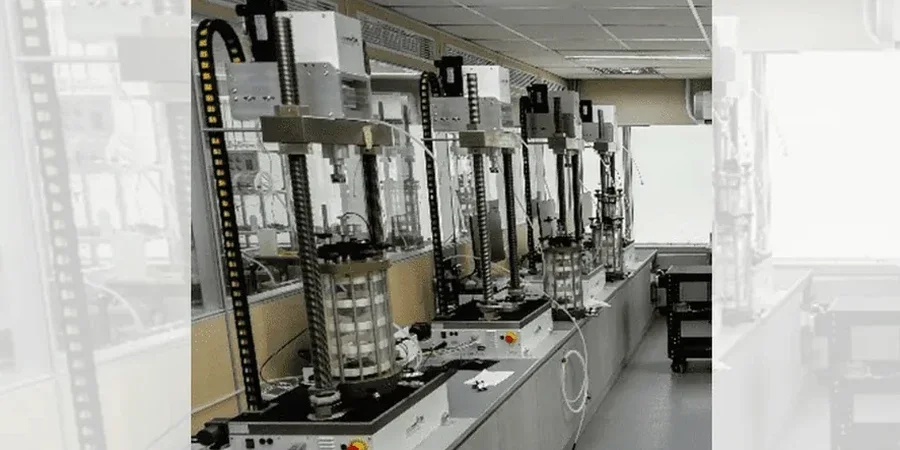
A triaxial cell sits in the load frame, confining pressure lines connected, pore pressure transducers zeroed. In Laramie, where the Sherman Granite and underlying sedimentary sequences dictate foundation design, this equipment must be calibrated for the 7,200-foot elevation. The cell applies isotropic stress to a cylindrical specimen while the axial piston drives at a controlled strain rate. Our Laramie lab runs consolidated-undrained (CU) and unconsolidated-undrained (UU) protocols per ASTM D4767, adapting saturation procedures for the low atmospheric pressure that affects back-pressure saturation. For projects near the Laramie River or along the I-80 corridor, we often combine triaxial data with field CPT soundings to calibrate undrained shear strength profiles where soft lacustrine clays are present.
Shear strength parameters from triaxial testing define the failure envelope that every Laramie retaining wall and slope design depends on.
Questions and answers
What is the turnaround time for triaxial testing in Laramie?
Standard consolidated-undrained triaxial tests typically require 10 to 14 business days from specimen receipt to final report. Saturation and consolidation phases alone can take several days depending on soil permeability. Expedited scheduling is available for active construction projects.
How much does a triaxial test program cost?
A triaxial testing program in Laramie generally ranges from US$2,060 to US$2,850, depending on the number of specimens, confining stress levels, and whether effective stress or total stress protocols are needed. Multi-stage testing on a single specimen can reduce the per-point cost.
What soil types in Laramie require triaxial testing rather than direct shear?
Triaxial testing is preferred for saturated fine-grained soils where pore pressure measurement matters—specifically the lacustrine clays and silts of the Laramie Basin. Direct shear cannot control drainage or measure excess pore pressure, making triaxial essential for undrained strength assessment in these materials.
Do you test rock cores with triaxial equipment?
Yes. We run triaxial compression on rock cores from the Casper and Fountain formations using a high-capacity load frame. Confining pressures up to 1,500 psi simulate deep foundation conditions. Specimens are prepared to a length-to-diameter ratio of 2:1 per ASTM D7012.