← Home · In-Situ Testing

Sand Cone Density Testing in Laramie, WY

Together, we solve the challenges of tomorrow.

LEARN MORE →

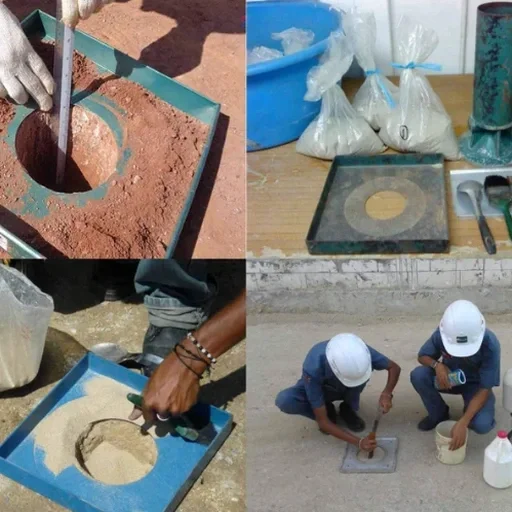
Laramie's development spread from the railroad yards near the Laramie River onto the weathered granite benches of the Laramie Range foothills. Many commercial pads along Grand Avenue and residential subdivisions near the University sit on engineered fill placed over decomposed bedrock. The transition from natural colluvium to compacted structural fill demands strict density verification. We run the sand cone density test per ASTM D1556 on active job sites across Albany County. The method provides a direct measurement of in-place density and moisture content. Lab correlation with a one-point Proctor (ASTM D698) lets the site supervisor know within hours whether the lift meets the 95 percent compaction threshold specified in the geotechnical report. At 2,190 meters elevation, Laramie's freeze-thaw cycles punish under-compacted fill, making this verification non-negotiable.

A single lift placed below 90 percent modified Proctor in Laramie's expansive clay zones can cost the owner a slab replacement within three freeze-thaw seasons.

Methodology and scope

Laramie's semi-arid climate means surface moisture can swing from saturated during spring snowmelt to bone-dry by August. These swings affect sand cone results directly. Dry granular fill from the local Sherman Granite quarries can trickle out of the cone base plate if the technician doesn't seal the plate edge with bentonite slurry. We calibrate the graded Ottawa sand on site with a field balance and adjust for ambient temperature. When the fill contains cobbles larger than 2 inches — common in borrow from the Casper Formation — we switch to a large-scale density ring and correlate the result with a rock correction procedure from the lab. The test takes about 20 minutes per station. A five-point grid on a 30-by-40-foot building pad gives the contractor a reliable density profile before the next lift goes down. Documentation follows the IBC chapter 18 format required by the City of Laramie Building Division.
Sand Cone Density Testing in Laramie, WY
Technical reference image — Laramie

Local geotechnical context

A three-story mixed-use building on 3rd Street had a lift placed during a November cold snap. The sand cone test caught a density drop from 96 to 88 percent across a 20-foot strip where the pad froze before compaction. The contractor scarified and recompacted the lift the same afternoon. Without that mid-afternoon test grid, the frozen layer would have become a planar weakness under the slab. Laramie's high diurnal temperature range — often 30 degrees Fahrenheit between dawn and mid-afternoon in October — means compaction windows close fast. Fill placed on frozen subgrade never regains design density after thaw. We also check for gypsum-rich lenses in the Satanka Formation, which can collapse upon wetting. A pre-placement plate load test on the prepared subgrade confirms the modulus before fill placement begins, closing the loop on the earthwork QA chain.

Need a geotechnical assessment?

Reply within 24h.

Email: [email protected]

Typical values

ParameterTypical value
Standard test methodASTM D1556 / AASHTO T 191
Cone base plate diameter6.5 inches (165 mm)
Test depth range4 to 8 inches typical; up to 12 inches with extension
Field sand calibrationBulk density at ±0.5 pcf precision
Compaction specification95% standard Proctor (ASTM D698) or 92% modified (ASTM D1557)
Report turnaround on siteWet density within 10 minutes; dry density after lab moisture
Applicable fill typesGranular, silty sand, crushed aggregate, minus-2-inch cobble mix

Related services

01

In-Place Density by Sand Cone

ASTM D1556 testing on 6- to 12-inch lifts. Includes field moisture by hotplate or Speedy meter and same-day dry density calculation against lab Proctor data.

02

Modified Proctor Testing

ASTM D1557 compaction curves on site-borrow samples. We run the Proctor in our Laramie lab before the first lift hits grade so the target density is established.

03

Nuclear Gauge Correlation

When the spec allows nuclear method, we correlate the gauge against sand cone readings at five points per lift to build a site-specific calibration curve.

Applicable standards

ASTM D1556 — Standard Test Method for Density and Unit Weight of Soil in Place by Sand-Cone Method, ASTM D698 — Standard Proctor for laboratory compaction reference, IBC Chapter 18 — Soils and Foundations for commercial projects in Wyoming

Questions and answers

How much does a sand cone density test cost on a Laramie job site?

A single sand cone test station typically runs between US$90 and US$130, depending on how many stations are on the lot. A full-day rate with the technician, equipment, and lab moisture correlation runs lower per test when we schedule a multi-station grid on one visit.

Which density test method does the City of Laramie accept for building pad sign-off?

The City of Laramie Building Division accepts ASTM D1556 sand cone results as a primary compaction verification method. The report must reference the laboratory Proctor curve (ASTM D698 or D1557) used as the reference and show the percent compaction for each station. Nuclear gauge results are also accepted if correlated to sand cone readings at the same site.

Can you run a sand cone test on fill that contains 3-inch cobbles?

Not directly with the standard 6.5-inch cone. For fill with oversize particles above 2 inches, we use a large-scale density ring (ASTM D5030) or a test pit replacement method. A rock correction is applied to the lab Proctor so the field density target accounts for the fraction of oversized material.

How soon after the test do we get the density report?

Wet density is available on site within 10 minutes. The dry density and percent compaction come the same day once the moisture sample is dried in the lab. For large earthwork operations, we can set up a mobile lab on site and deliver a stamped QA report within two hours of the test.
Location and service area

We serve projects in Laramie and surrounding areas.

View larger map