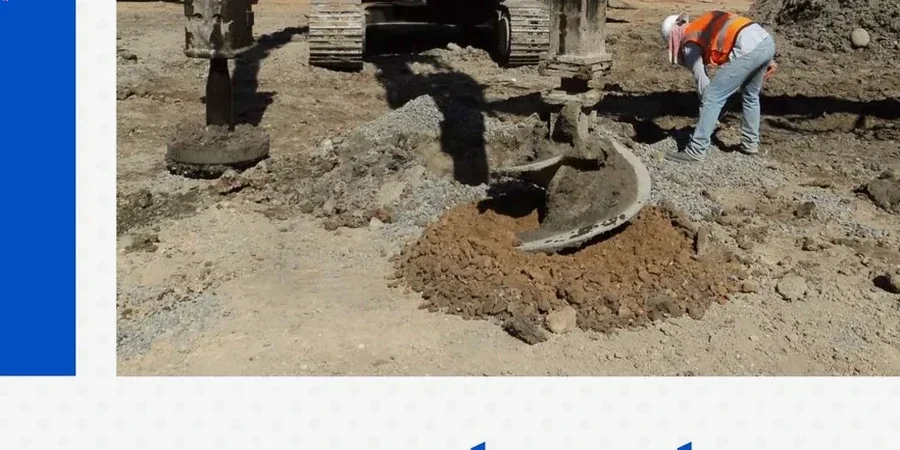
The most common mistake we see in the Laramie Basin is treating a poor soil report as a minor inconvenience. An engineer gets a blow count of 3 from an SPT drilling program, the structural loads come back high, and suddenly a standard spread footing isn’t viable. That’s when someone suggests overexcavating six feet and replacing it with structural fill. In Laramie, where the water table can sit surprisingly high in the alluvial deposits near the Laramie River, that approach turns into a dewatering nightmare—and a change order that sinks the budget. Stone column design offers a different path. Instead of fighting the native soil, we reinforce it. The technique uses compacted granular columns to transfer loads past the soft zone and into more competent strata below, increasing shear strength and accelerating consolidation. For commercial projects along Grand Avenue or new residential subdivisions pushing east into the basin’s silty clays, this approach often eliminates the need for deep foundations while keeping settlement within IBC tolerances. The key is getting the column spacing, diameter, and length right—and that starts with site-specific geotechnical data, not a generic textbook solution.
At 7,200 feet elevation with freeze-thaw cycling and highly plastic clays, Laramie demands a stone column design that accounts for drainage, frost penetration, and long-term creep—not just bearing capacity.
Methodology and scope
Laramie’s development pattern followed the Union Pacific Railroad in the 1860s, and much of the early construction clustered on the relatively well-drained terraces above the Laramie River floodplain. As the city grew westward toward the Snowy Range foothills and eastward into the basin, builders encountered increasingly variable subsurface conditions: stiff, desiccated clays over soft alluvium, weathered shale, and pockets of wind-deposited silt that collapse under load. Today, when we design stone columns, we’re dealing with that same stratigraphic complexity. A typical Laramie Basin profile might show 12 feet of soft clay overlying a dense gravel layer—ideal for floating columns that terminate in the bearing stratum. In other locations, we’re looking at 30 feet of compressible soil with no clear refusal, requiring a
triaxial shear test to calibrate the composite shear parameters of the treated ground. Our approach leans heavily on the unit cell concept from Priebe’s method, but we adapt it for the stiff crust effect common in Wyoming’s semi-arid clays. Ignoring that crust overestimates settlement and leads to an over-designed, unnecessarily expensive grid. We also specify the aggregate gradation carefully—clean, angular stone with less than 5% fines—to ensure drainage capacity without clogging over decades of freeze-thaw cycling at 7,200 feet elevation.
Questions and answers
What does stone column design cost for a typical Laramie commercial project?
For a standalone stone column design package—including layout, settlement analysis, specifications, and QA/QC plan—fees typically range from US$1,250 to US$4,480 depending on the building footprint, number of columns, and whether post-treatment verification testing is included. A 15,000-square-foot retail pad with straightforward stratigraphy usually lands on the lower end; a larger footprint with variable soils and multiple loading zones pushes toward the upper end.
When are stone columns a better choice than deep foundations in Laramie?
Stone columns become the preferred option when the soft layer is less than about 35 feet deep and the structure can tolerate moderate settlements—typically one inch or less per IBC criteria. In Laramie, we often recommend them for one- to three-story commercial buildings and lightly loaded industrial slabs where the alternative would be grade beams on drilled piers. The cost advantage comes from eliminating the structural slab and reducing the foundation depth.
How do you account for Laramie’s freeze-thaw cycles in stone column design?
We specify a non-frost-susceptible cap layer—usually 12 to 18 inches of clean granular material—above the stone columns and below the floor slab or footing. The column aggregate itself is graded to minimize capillary rise, and we verify that the groundwater table is at least 5 feet below the frost penetration depth, which in Albany County is typically 48 to 60 inches per local building code.
What field testing is required to verify stone column performance?
We require modulus load tests on at least 5% of installed columns, with a minimum of three tests per distinct soil zone. The test applies a load to a single column and measures deflection under a specified stress, typically 1.5 times the design bearing pressure. For critical structures, we also run post-treatment CPT soundings at column centroids and midpoints to confirm the composite shear strength profile matches the design assumptions.